Urgent Pet Care Blogs

by Dr. Haley Holbrook | Updated September 16, 2026
You’re at Urgent Pet Care with your clearly uncomfortable pet. They’ve itched their ear to the point where it’s bright red. Dogs are barking, and there’s a lot of chatter both in the waiting room and in the back of the clinic. The CSR just placed you into an exam room, but tells you that it might be another 45 minutes before they can collect patient history. You’ve already waited half an hour. What is taking so long? Why does it take so much time to be seen at a veterinary urgent care?
Patients present to us with a wide array of ailments at any moment. A patient can come in for unexplained limping at nearly the same time that another patient is rushed in after being hit by a delivery truck, and another patient with an eye injury is on the way. In order to manage cases with all pets’ best interests in mind, we use a method called triage.
What is Triage and Why is it Used?
Triage is a concept that is widely used in both human and veterinary medicine. This method systematically sorts patients into different groups based on the severity of their condition. From there, triage requires that patients who are experiencing life-threatening conditions are seen first.
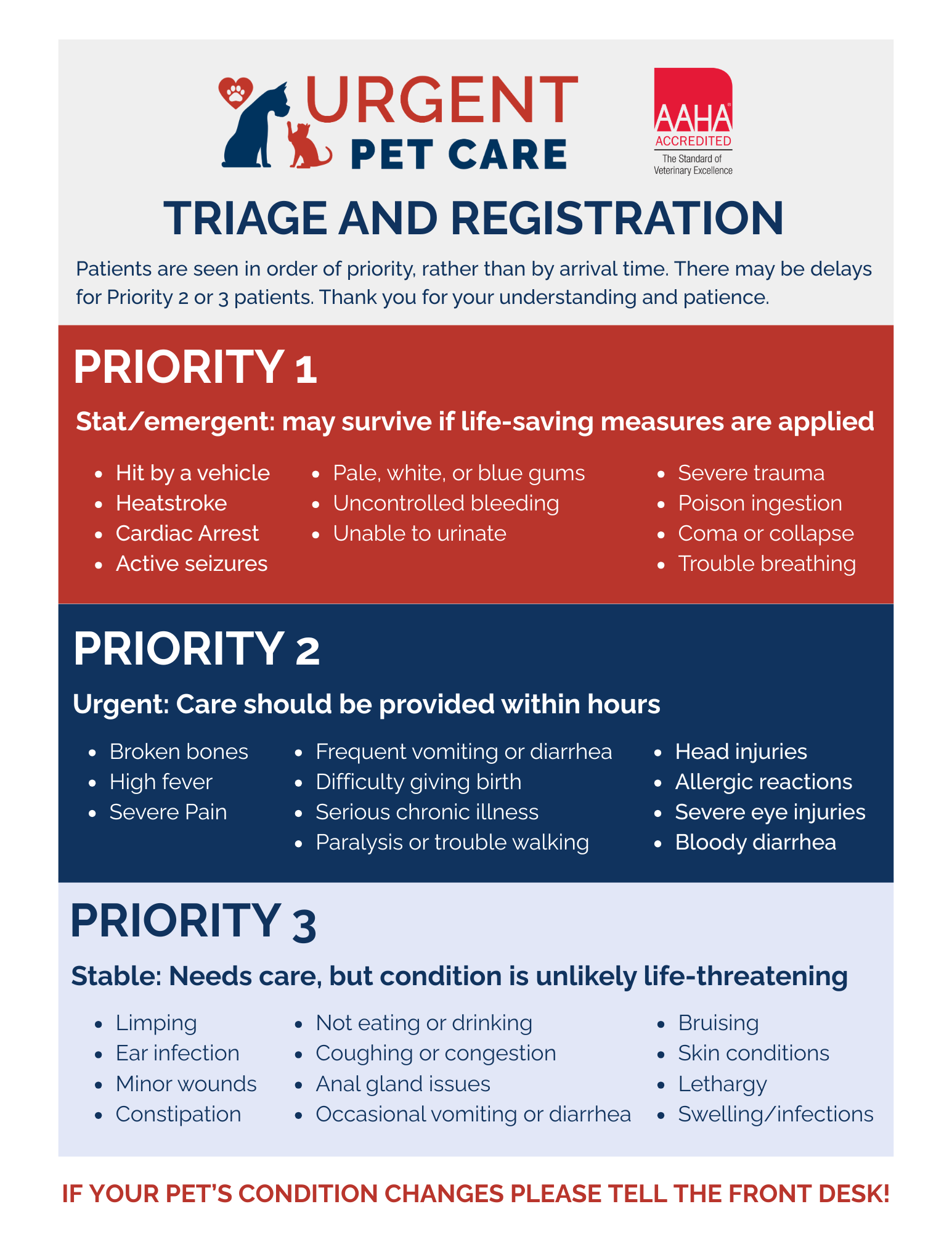
At Urgent Pet Care, patients are seen in order according to 3 priorities, with Priority 1 patients being seen first, and Priority 3 patients being seen last. Triaging dictates that we do not see patients exclusively in order of arrival. By giving priority to patients based on the severity of their conditions, we can save more lives when every second is critical.
PRIORITY 1: STAT/EMERGENT
These patients may survive if life-saving measures are taken quickly.
- Hit by a vehicle
- Heatstroke
- Cardiac Arrest
- Actively experiencing seizures
- Severe trauma
- Poison ingestion
- Coma or collapse
- Trouble breathing
- Pale, white, or blue gums
- Uncontrolled bleeding
- Unable to urinate
PRIORITY 2: URGENT
Care needs to be given within hours of arrival, but are not in critical condition like Priority 1 patients.
- Broken bones
- High fever
- Severe Pain
- Head injuries
- Allergic reactions
- Severe eye injuries
- Bloody diarrhea
- Frequent vomiting or diarrhea
- Difficulty giving birth
- Paralysis or trouble walking
PRIORITY 3: STABLE
These patients need care, but their conditions are unlikely to be life-threatening or immensely painful like the conditions in Priority 1 or Priority 2 are.
- Limping
- Ear infection
- Minor wounds
- Constipation
- Bruising
- Swelling/infections
- Skin conditions
- Lethargy
- Not eating or drinking
- Coughing or congestion
- Anal gland issues
- Occasional vomiting or diarrhea
If you’re waiting for care, we recommend taking the following actions:
Notify staff immediately if you see changes in your pet’s behavior. Especially during busy weekends, nights, or holidays, we may not know that your pet’s demeanor is changing without your input. Changes in how your pet is acting may indicate that their condition is deteriorating–if that’s the case, their placement for triage may change.
Stay calm and comfort your pet. Veterinary offices are often filled with strange sights, sounds, and smells, and it can sometimes be overwhelming for our beloved pets. Do what you can to remain calm and keep your pet comfortable while waiting to be seen.
Make sure your pet is safely contained. Even if your pet is friendly, other pets that come into UPC may not be. At UPC, we require that all cats be contained in a pet carrier, and that all dogs either be restrained with a leash that is non-retractable (if they are an especially large breed), or be contained in a pet carrier if practical for the dog’s size while in our waiting room. This is to help ensure that all pets stay safe while at our veterinary practice.
Apply for Care Credit or Scratch Pay if you’re concerned about costs. We know that the full costs of quality emergency veterinary care can be difficult to manage. If you’re worried about the cost of your visit before you see any estimates, applying for financing options may help give you some peace of mind.
Urgent Pet Care wants to help families afford the care they need, and that’s why we work closely with CareCredit and Scratch Pay. These companies help clients find payment plans that will work within their monthly budget to cover the costs of emergency veterinary care.
Look into Trupanion Pet Insurance. While pet insurance may not help cover the costs of your current visit, it may help cover future vet visits. Urgent Pet Care strongly recommends Trupanion to all of our clients. Unlike most pet insurance, which work off of a reimbursement model (where pet parents pay full costs upfront and work with insurance later on to get reimbursed), Trupanion works directly with veterinary practices to pay for covered services upfront. That way, pet parents only need to pay a portion of the visit costs at checkout.
If you don’t have a primary care veterinarian, start looking online. Primary veterinarians, who see pets for annual check-ups and more minor medical issues, are on the frontlines of the prevention and treatment of many medical issues. By scheduling regular check-ups with a veterinarian, it is more likely that chronic conditions will be caught early on and can be treated or more effectively managed. While we work directly with primary care veterinarians by sending patient records and working together to develop treatment plans after a patient is discharged from Urgent Pet Care, we do not see patients for routine visits.